
Earlier this spring, we surveyed 501(c) Services members to better understand the HR and workforce challenges they are navigating right now. The results are below.
These findings offer a useful benchmark for nonprofit HR and operations leaders, a way to see how their own challenges and support strategies compare to what peers across the sector are experiencing. They also surface a few gaps that are worth paying attention to.
Key Takeaways
- Legal counsel is the most widely used outside HR resource, cited by nearly three out of four respondents, which raises questions about whether organizations are getting the right kind of support at the right stage.
- Leadership transition and succession planning is the top unmet need, with 79% of respondents expressing interest in advisory support in this area.
- Retention and internal investigations involving senior staff are close behind, each drawing strong interest despite being among the most difficult challenges for smaller organizations to address internally.
- The data reflects a sector that knows it needs support. Only 1% of respondents reported seeking no outside HR guidance at all.
Where Nonprofits Are Turning for HR Guidance
One of the clearest findings from the survey involves where organizations go when they need outside support on HR matters. Legal counsel ranked first by a wide margin, cited by 73% of respondents. Other commonly used sources of guidance included:
- 501(c) HR Services: 42%
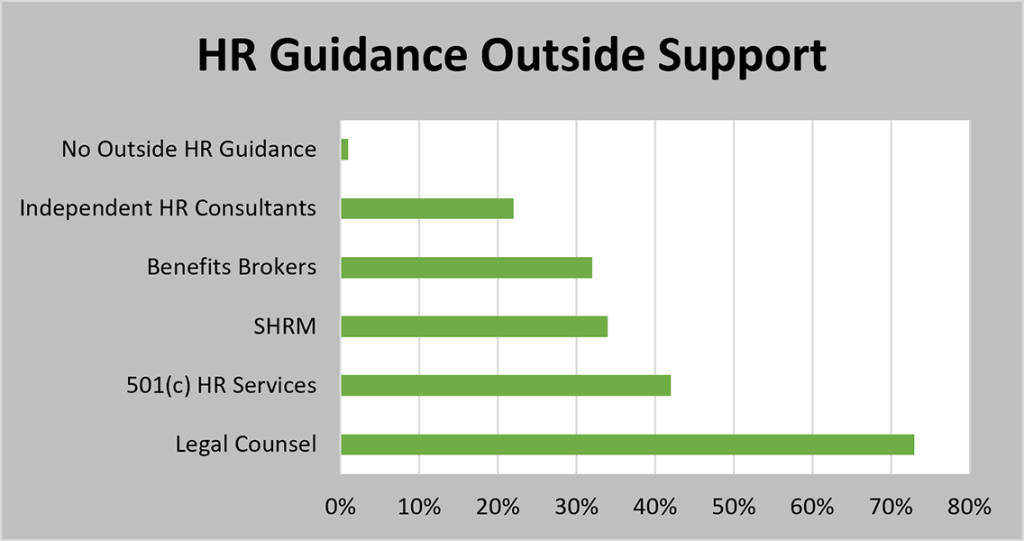
- SHRM or similar professional associations: 34%
- Benefits brokers or insurance providers: 32%
- Independent HR consultants: approximately 22%
Only 1% of respondents reported seeking no outside HR guidance at all. The vast majority of organizations are actively looking for support somewhere. The question is whether the resources they are using match the nature of the challenges they face.
What Nonprofits Say They Need Most
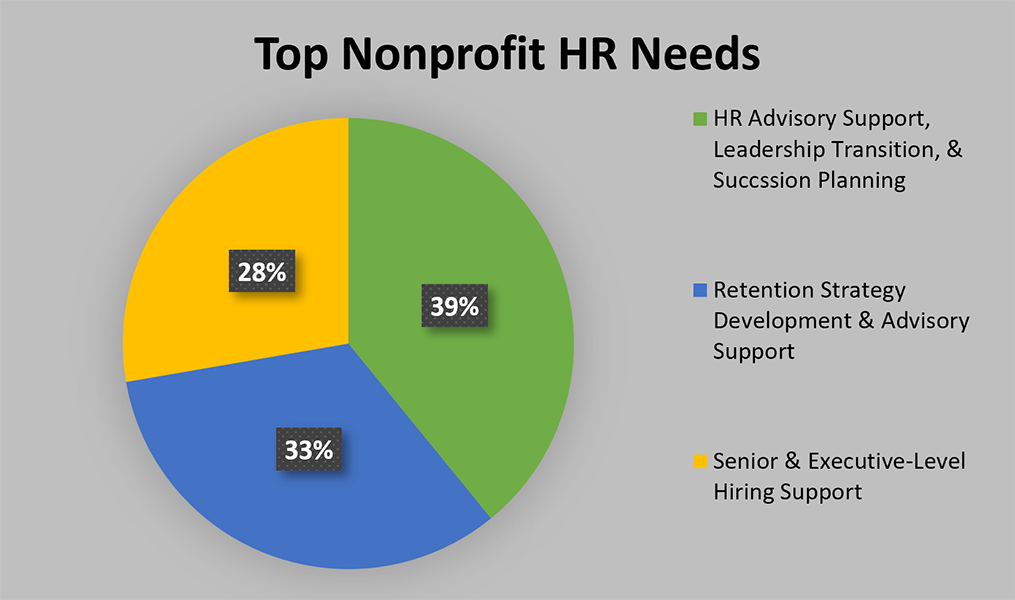 When respondents were asked to rate their interest in four specific areas of HR advisory support, leadership transition and succession planning came out on top by a significant margin: 79% indicated they were very or somewhat interested in support in this area.
Retention strategy development and advisory support for internal investigations involving senior or executive-level behavior each drew 67% combined interest. Both represent situations where the stakes are high, internal capacity is often limited, and the cost of a misstep in turnover, legal exposure, or organizational culture can be significant.
Senior and executive-level hiring support was the least compelling service area, with 56% of respondents indicating they were not interested. This likely reflects a degree of confidence in existing search committee and board-led processes, or simply a different prioritization given limited budgets and bandwidth.
Where the Gaps Are
The survey results are useful not just for what they reveal directly, but for what they suggest about where nonprofit organizations may be underserved or underprepared.
The reliance on legal counsel deserves a closer look. When nearly three-quarters of nonprofits are routing HR challenges primarily to attorneys, it raises a practical question: are these issues being addressed at the right stage? Legal counsel is essential, and in many situations irreplaceable. But attorneys are typically engaged after a situation has already become complicated. HR guidance tends to be most valuable earlier in the process, when prevention is still possible. Organizations that default to legal counsel as their primary HR resource may find themselves managing problems reactively rather than getting ahead of them.
Interest in succession planning is high, but action likely lags behind. Nearly 80% of respondents flagged leadership transition and succession planning as an area where they want support, but interest and preparation are not the same thing. The nonprofit sector has a long history of underinvesting in succession planning until a departure forces the issue. This data suggests organizations recognize the vulnerability. The harder challenge is moving from awareness to a plan before it becomes urgent.
Retention concern is widespread, but strategic approaches are inconsistent. Two-thirds of respondents expressed interest in retention strategy support, which tracks with broader sector trends showing persistent turnover across nonprofits of all sizes. Wages, burnout, and competition from the private sector have all intensified retention challenges in recent years. Many organizations are still responding to turnover after the fact rather than building proactive frameworks to address it.
The investigation gap is underappreciated. 67% of respondents expressed interest in support for internal investigations involving senior or executive-level behavior. This is a sensitive area that most smaller nonprofits are not equipped to handle internally. Investigations involving leadership require a level of independence, documentation rigor, and HR expertise that is difficult to maintain when the HR function is lean or when the subject of the investigation is a supervisor or executive. The interest level in the survey suggests many organizations are already aware of this exposure.
What This Means for Your Organization
No single finding from this survey applies universally to every nonprofit. Organizations vary in size, mission, geography, and HR capacity, and the right approach to workforce challenges will look different depending on those factors.
What the data does offer is a point of comparison. If your organization’s primary outside HR resource is legal counsel, it may be worth considering whether earlier-stage interventions could reduce how frequently legal involvement becomes necessary. If succession planning has not been a recent priority, the 79% who flagged it as a need may be a useful prompt. And if retention is a recurring challenge rather than a strategic focus, the gap between concern and action is worth narrowing.
We will continue to share research and insights from across our member community. If you have questions about the survey findings or want to discuss what they mean for your organization, we would be glad to hear from you.
About Us
For more than 40 years, 501(c) Services has been a leader in offering solutions for unemployment costs, claims management, and HR support to nonprofit organizations. Two of our most popular programs are the 501(c) Agencies Trust and 501(c) HR Services. We understand the importance of compliance and accuracy and are committed to providing our clients with customized plans that fit their needs.
Contact us today to see if your organization could benefit from our services.
Are you already working with us and need assistance with an HR or unemployment issue? Contact us here.
The information contained in this article is not a substitute for legal advice or counsel and has been pulled from multiple sources.
(Images by Armmypicca and Rawpixel-com)